Intelligent control systems for commercial energy
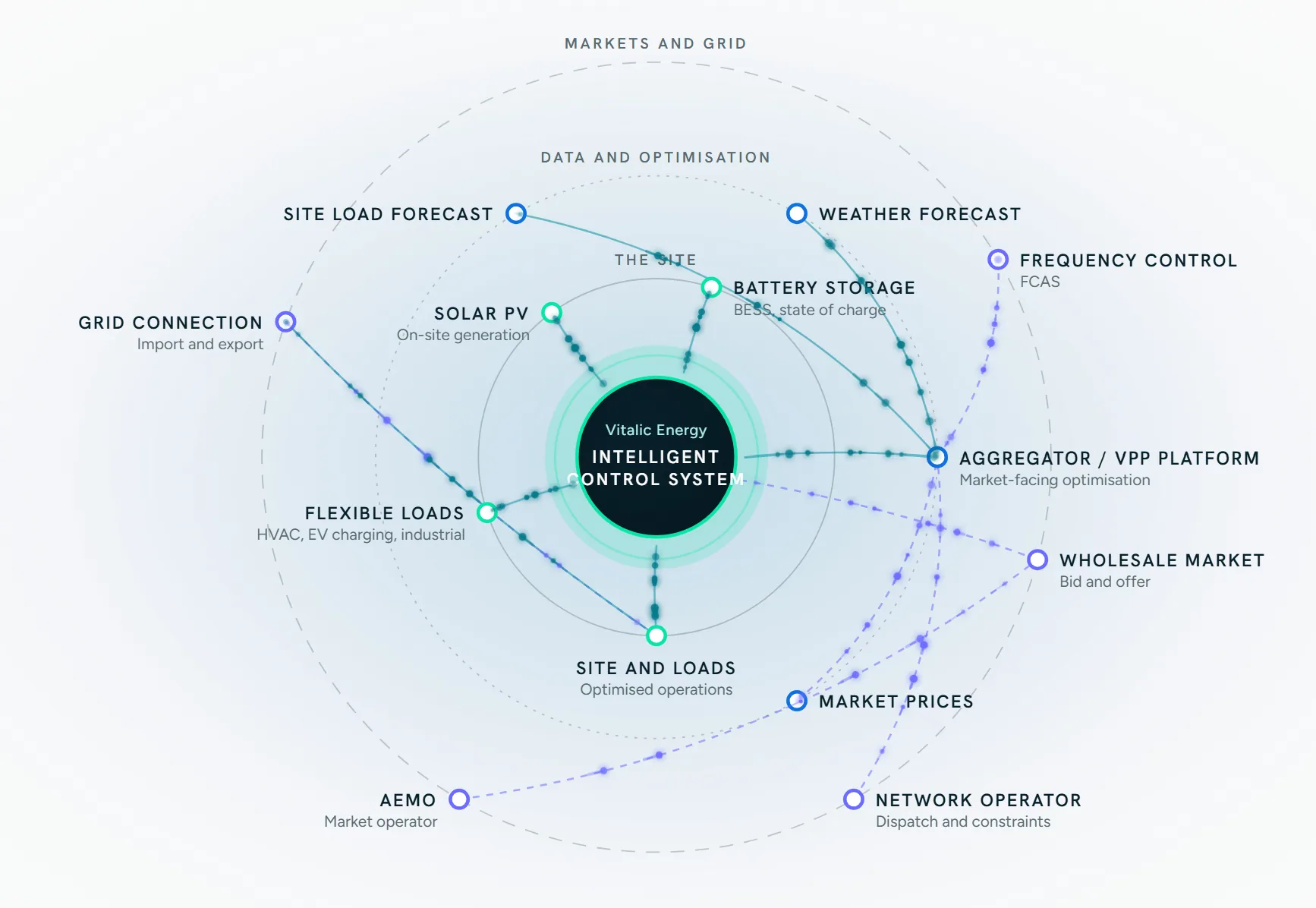
Intelligent control owns no hardware, so on its own it does nothing. What it does is decide which of the other four pillars acts, and when, re-deciding every 0.1 seconds against price, network and site signals. That decision is what lets one battery earn from up to five value streams instead of one. It is the multiplier, not a fifth product.
Last updated 20 October 2026
At a glance
- Saves
- Chooses the cheapest source every 0.1 seconds
- Earns
- Bids the right asset in the right interval
- On its own
- Nothing. It owns no hardware
- Effect
- Lets one battery earn from up to five value streams, not one
What the control layer actually reads
Three signals feed in continuously: site load, network tariff position, and wholesale price. The control layer forecasts each, weighs the competing claims on the same asset (hold charge for the demand peak, or discharge into the current spike), then dispatches. Wholesale prices settle every five minutes, so a decision cycle measured in hours misses the intervals that carry the value.
Why simple dispatch logic strands value
The logic for solar self-consumption is simple. The logic for capturing wholesale arbitrage while preserving capacity for peak demand reduction, while maintaining FCAS-ready state of charge, while responding to tariff changes in real time, is another problem entirely. It requires forecasting, optimisation across competing streams, dispatch in seconds, integration with metering and market signals, and ongoing tuning.
Accountability after commissioning
Tariffs and markets keep moving after handover, so a control-led system is tuned continuously rather than commissioned and left. Performance accountability extends past equipment warranty, the party that specified the dispatch logic stays answerable for what it delivers.
How control works with the other four pillars
Common questions about intelligent control
What does an intelligent control system do?
It decides which energy asset acts and when, re-deciding every 0.1 seconds against price, network and site signals. It forecasts load, generation and pricing, optimises across competing value streams, and dispatches generation, storage and flexible load accordingly.
Why is a 0.1-second decision interval necessary?
Because wholesale prices settle every five minutes and a demand peak can be set in a single interval. Decisions made on an hourly cycle miss both. Sub-second dispatch is also what makes FCAS participation possible.
Can intelligent control be added to existing solar or battery assets?
Usually yes. Existing assets are generally kept and brought under control rather than replaced, the assessment establishes what the installed hardware can be instructed to do.
What is a virtual power plant?
A virtual power plant is a fleet of separately owned energy assets — batteries, solar systems and flexible loads across many sites — coordinated so they can be dispatched together as if they were a single generator. For a commercial site, participating means the on-site battery responds to market signals alongside others, earning from capacity it was not otherwise using. What makes it possible is the control layer, not the hardware.
What is FCAS, and can a commercial battery earn from it?
FCAS stands for Frequency Control Ancillary Services: the markets that keep the grid at fifty hertz by paying assets to inject or absorb power within seconds. A commercial battery can earn from FCAS, and it is one of the five value streams, but only if it is registered and its control system can respond fast enough. Most commercial batteries are never registered, so the revenue is left uncaptured.
What are distributed energy resources, and what is a DERMS?
Distributed energy resources are generation, storage and controllable load connected at the customer end of the network rather than at a power station — rooftop solar, batteries, EV chargers and flexible plant. A DERMS, or distributed energy resource management system, is the software that coordinates them. On a single commercial site that means one control layer deciding which asset acts in each interval, rather than four systems each optimising alone.
What does "behind the meter" mean?
Behind the meter means on the customer side of the electricity meter — equipment you own, generating or storing energy that serves your own load before it touches the grid. Energy used behind the meter displaces electricity at the retail rate rather than earning the much lower export rate, which is why self-consumption is usually worth more than export. It is also the boundary that separates what you control from what the network does.
What intelligent control is worth on your site
Twelve months of NMI interval data and your current tariff is enough to model it against your real load.