
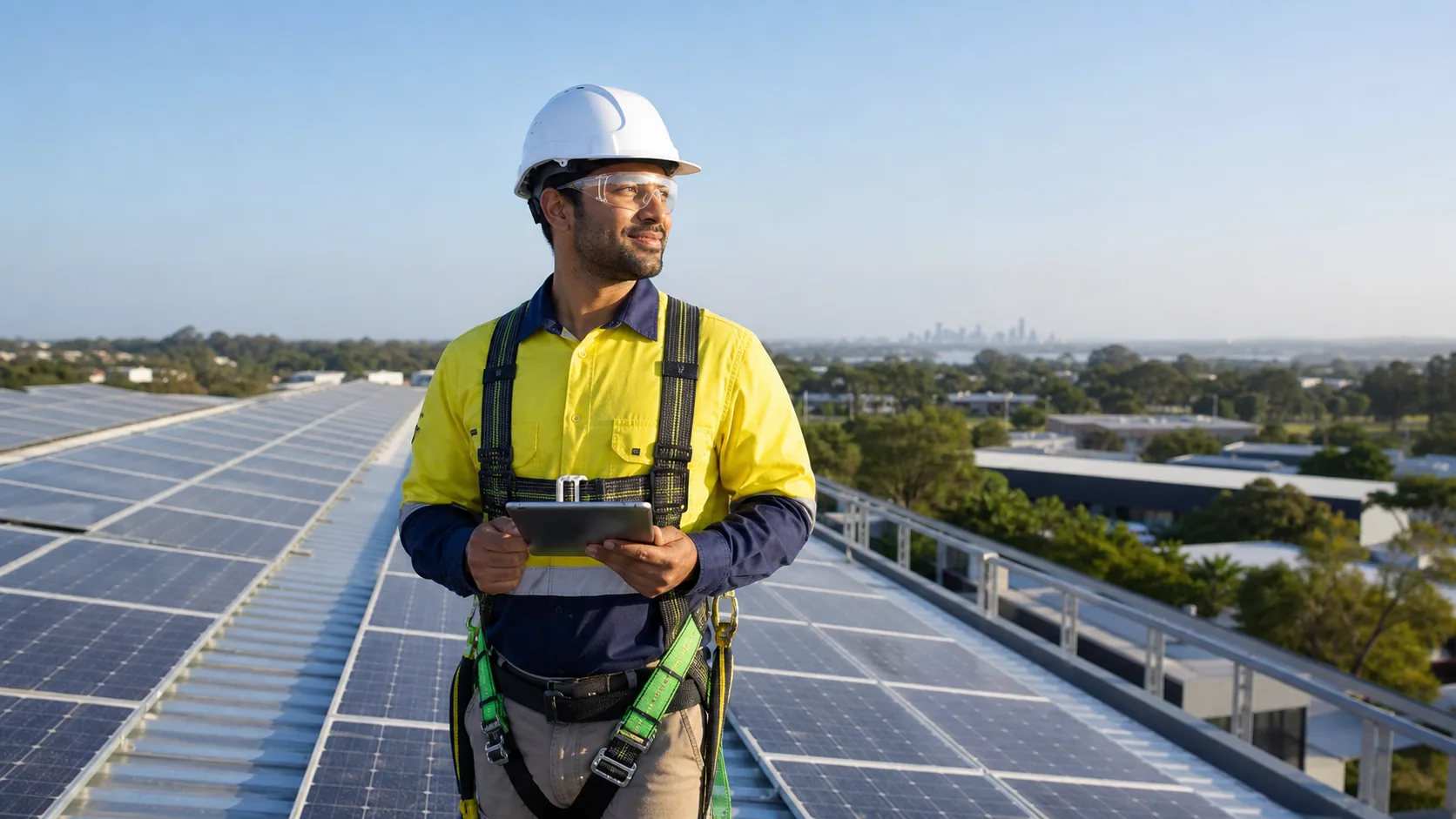
Four stages, one accountable party.
Every system runs through the same four stages under a single EPC contract. Because one party carries the whole scope, there is no gap between the party who designed the system and the party answerable for how it performs.
Stage 01
Strategy and feasibility
We assess site conditions, tariffs, consumption patterns and commercial objectives to identify where value can be created, starting from twelve months of interval data.
Stage 02
Engineering and design
Systems are engineered for performance, compliance, scalability and long-term integration with future storage and control assets.
Stage 03
Installation and integration
We manage procurement, installation and commissioning to commercial standards, integrating into existing site infrastructure and operational systems.
Stage 04
Optimisation and support
Performance is continuously monitored and refined to maximise long-term returns. Tariffs and markets keep moving after handover, so tuning does not stop at commissioning.
Built on experience that delivers measurable outcomes.
Our approach is grounded in proven delivery across complex commercial energy systems.
- 01Founder-led delivery experience across complex, multi-site commercial and industrial energy programs.
- 02More than a decade of C&I solar, storage and energy-management delivery in Australia.
- 03Delivery across complex, multi-site energy systems where reliability and financial outcomes are critical.
- 04Strategic supply partnerships supporting long-term energy programs, selected per site rather than by standing agreement.
Your energy system is built on five integrated components.
Each component is engineered to operate as part of a single system, delivering coordinated performance across cost, risk and revenue.
| Component | Engineering intent | Contribution |
|---|---|---|
| Optimised generation | Solar sized to the load profile, not the roof area, to maximise self-consumption | Lowest-cost energy during daylight hours |
| Storage | Power and energy sized separately against the value streams the site can access | Time-shifting, demand-peak reduction and dispatch |
| Demand management | Wireless mesh control on flexible load, installed without hardwired BMS retrofit | Load reshaped without touching production |
| EV charging | Bays sized to what the site’s switchboards can supply, controlled so charging does not set a new demand peak | Charging from your own solar first, then battery or grid whenever the price covers the cost |
| Intelligent control | Dispatch logic specified before hardware, decisions re-made every 0.1 seconds | Lets one battery earn from up to five value streams, not one |
What procurement teams ask first.
What licensing and accreditation does a compliant installation need?
Two things, and they are separate. Electrical work must be carried out under an electrical contractor licence. STC and rebate eligibility additionally requires the system to be designed and installed by an installer accredited under the national scheme — accreditation that transferred from the Clean Energy Council to Solar Accreditation Australia in 2024, so a current certificate will not carry the Clean Energy Council name.
What does a single EPC contract cover?
One contract covering all five layers, generation, storage, demand response, EV charging and intelligent control, across strategy and feasibility, engineering and design, installation and integration, and ongoing optimisation. One party is accountable for the performance of the whole system rather than for individual equipment warranties.
Who is accountable for system performance after commissioning?
Vitalic. Performance accountability extends beyond equipment warranty into ongoing optimisation, because a control-led system is tuned against tariffs and market conditions that continue to change after handover.
Does Vitalic use a single equipment vendor?
No. Equipment is selected per site against the value streams the system needs to capture. Vitalic is multi-vendor by design, so the specification follows the engineering rather than a supply agreement.
Backed by proven delivery and long-term performance.
Bring us twelve months of interval data and we will show you the system your site can actually justify.